
I recently spent a few days at Devrai Art Village in Panchgani, making things for Kaari Kanteen.
It is one of those places that makes you rethink what you thought you knew about Indian craft.
Set within a lush forest garden, Devrai brings together artisans, artists and makers from different parts of India, working across materials, techniques and traditions. What stayed with me most wasn’t one particular object, but the attitude towards tradition itself.
At Devrai, tradition doesn’t feel like something preserved behind glass. It’s something you can pick up, question, stretch, combine and make your own.
They have developed Rock Dhokra, a process that brings together stone and metal through the lost-wax technique. They experiment with organic casting, beaten metal, wood, ceramics and more. The work is deeply rooted in Indian craft traditions, but it doesn’t always look like what we have collectively decided Indian craft is supposed to look like.
And that got me thinking.
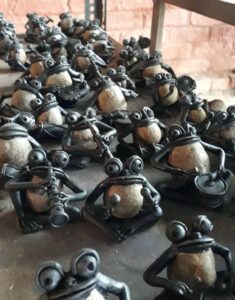
Frog parade in Rock Dhokra by @devraiartvillage
What actually makes something Indian?
Is it the material?
The technique?
The story?
The person who made it?
Or does it have to look a certain way before we allow ourselves to call it Indian?
I think we have confused cultural identity with visual familiarity.
We have somehow built a very narrow visual vocabulary for “Indian”.
Miniature paintings. Elephants. Jaali. Paisley. Marigolds. Brass bells. Block prints. A little bit of Jaipur thrown into the background for good measure.
None of these things are not Indian. They are deeply Indian.
But when these become the only visual language through which we recognise India, something starts to feel strange.
Because India itself has never been that visually static.
And perhaps there is a larger, more uncomfortable history underneath this.
There is something distinctly colonial about reducing a complex, contradictory and constantly evolving civilisation into a collection of recognisable images.
The colonial gaze often needed India to be legible. To be categorised. To be packaged into types, traditions and picturesque fragments that could be understood from the outside.
But somewhere along the way, some of those fragments became our own shorthand for ourselves.
The irony is that we can become so accustomed to seeing ourselves through a particular frame that eventually we mistake the frame for the whole picture.
That is where I think the decolonial question becomes interesting.
Political independence gave us sovereignty. but what does cultural independence look like?
Are we truly independent if we inherit a limited idea of what India is, and then keep reproducing it?
If we can imagine India only through the same motifs, materials, monuments and visual codes that have already been labelled “Indian”, are we actually expanding our culture, or simply curating its most recognisable parts?
And this isn’t an argument against tradition.
Quite the opposite.
I think the most respectful thing we can do with a culture is allow it to have a future.
India has always been changing. Absorbing. Contradicting itself. Borrowing from elsewhere and making it its own. Turning spiritual ideas into geometry, stories into symbols, materials into new techniques and ordinary objects into things of ritual and meaning.
So why should Indian creativity stop evolving ?
Look at older Indian art and you find abstraction, geometry, symbolism, experimentation, surreal forms, strange proportions and ideas that don’t necessarily fit today’s Pinterest board of “Indian aesthetics”.
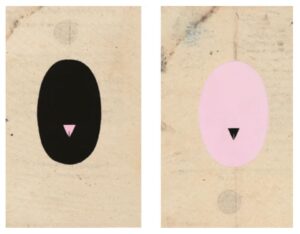
Indian art during the 17th century. credit : (@viaeast)
And yet, if something doesn’t immediately register as Indian to us, we question where it belongs.
We often ask whether something looks Indian enough, instead of asking whether it comes from an Indian context, responds to an Indian idea, builds upon an Indian practice, or simply reflects the reality of being Indian today.
This distinction matters to me because of Kaari Kanteen.
I don’t want to make things that are Indian because they contain enough recognisable Indian symbols.
I want to make things that are from India.
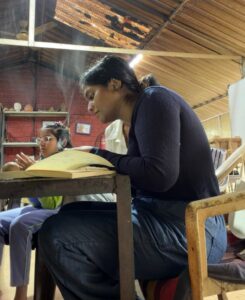
Work in Progress
There is a difference.
“Indian” can sometimes feel like a category with rules.
“From India” feels like an open-ended point of departure.
It leaves room for experimentation. For influence. For failure. For contradiction. For the completely new.
And perhaps that is what we forget when we talk about preserving craft.
Indian craft doesn’t have to be preserved by freezing it.
A traditional technique can meet a completely unfamiliar material.
A familiar story can be asked a different question.
Something inherited can be made useful again.
Something entirely new can still come from the Indian experience.
This is something I especially want to acknowledge about Mandakini Mathur ma’am, the founder of Devrai Art Village.
There is something incredibly generous about creating a space that doesn’t simply preserve craft, but gives craftspeople the freedom to imagine what their practices could become.
Devrai doesn’t seem interested in keeping tradition perfectly intact. It seems interested in keeping it alive.
Standing there, surrounded by people making, experimenting and figuring things out with their hands, the idea of evolving tradition stopped feeling like a philosophy and started feeling like an obvious truth.
Culture is not a museum exhibit.
It is a living, moving thing. It absorbs. It rejects. It adapts. It forgets. It remembers. It makes something new and then, eventually, that new thing becomes part of what we call tradition.
So perhaps this Independence Day, the question isn’t only whether we are politically independent.
Perhaps it is also:
Are we independent in how we imagine India?
Independent enough to look beyond the montage.
Independent enough to stop asking whether something looks Indian enough.
Independent enough to let India be strange, contemporary, contradictory, experimental and unfinished.
Independent enough to create an India that doesn’t need to resemble the India we were taught to recognise.
Because maybe the most radical way to inherit our history is not to reproduce it exactly, but to take the freedom it gives us and imagine further.
Maybe the most Indian thing we can make isn’t something that looks traditionally Indian at all.
Maybe it is simply something that could only have been imagined from here, by us, at this particular point in time.
And maybe that is what cultural independence looks like.
Not rejecting what came before us.
But becoming free enough to decide what comes next.