Today, on the occasion of Guru Purnima, I would like to pay my homage to River Krishna, who has been my most intimate Guru. She inspired me to flow along the slope of my deepest inclination, moving around the boulders that life keeps throwing in my path.
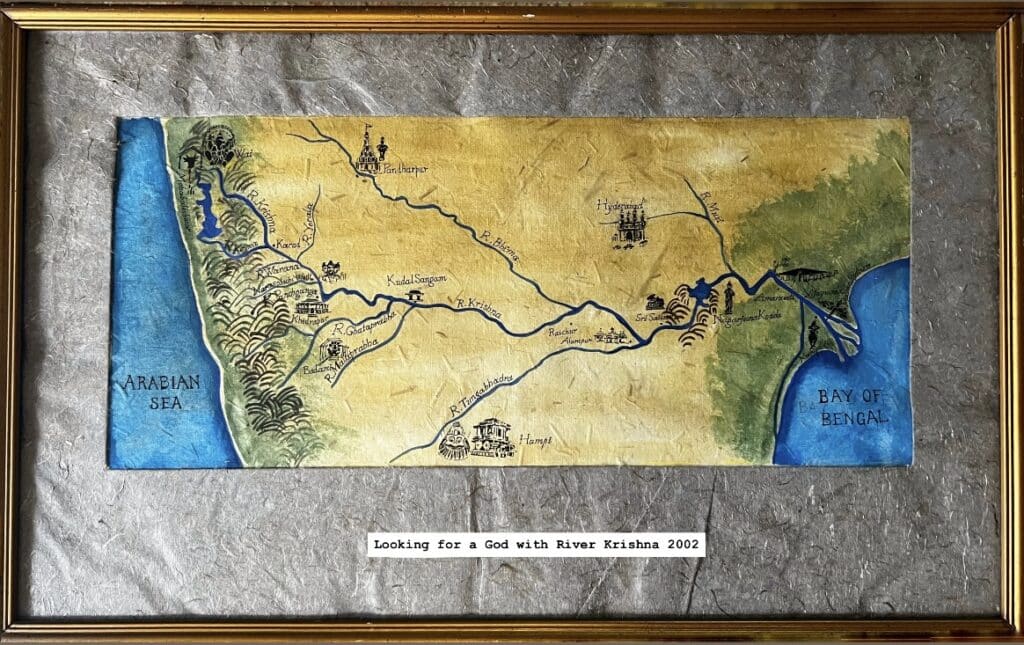
It has been over 25 years since I travelled along the river, looking for a God with my massive net of the thinking mind, but God seems to have slipped through the holes like water. So be it. Perhaps it’s time to fling the net away and share the story of my journey.
The summer of 1997 saw us shifting here to Panchgani from Mumbai with our two kids who were then six and three years old. That move was not like turning a page in the story of our lives, but rather like beginning an entirely new book! Now, when I quietly ask myself why we chose to leave Mumbai when life there was so alluring, the answer echoes back in a resounding voice: it was destined that we come here. Atul was climbing the corporate ladder in the advertising world. We were living in South Mumbai, close to the sea. Rudransh was going to BIS, an esteemed school in South Bombay, and Devansh was in a nursery run by the Chinmaya Mission, within walking distance of our home on Worli Seaface. My career as a French teacher had also found an outlet. I was teaching at the Alliance Francaise and had also found an opportunity to teach French to junior college students at Sydenham College of Commerce. In spite of all the lure and comforts that Mumbai could offer, the hills of Panchgani beckoned us like large magnets, and we were drawn towards it like bits of iron. So the iron resolve to quit Mumbai was not just perhaps ours alone!
We lived for eight years in a rented bungalow from where one could see the Krishna river snaking through the valley below. I knew the river had her source in the forests of Mahabaleshwar, but where did she go before becoming one with the sea on the other side of the Indian peninsula? I had never made a film before coming to Panchgani. French cinema was a subject of study for my MPhil dissertation. But here, filmmaking became a means of exploring the forests, interacting with children on child-centric themes, and it finally set me off on a spiritual journey when I got the opportunity to make a documentary on River Krishna for the Films Division, “Looking for a God with River Krishna”. It was the first time I was making a film with a professional crew. It took me over a year to complete the film, with four shooting schedules spread across different seasons along the river’s 1,280 kilometres. I did not limit my exploration to River Krishna alone but also followed two of her major tributaries—the Bhima and the Tungabhadra. I recall the kids’ response when asked about their mother’s whereabouts. “Oh, she’s gone looking for a God with River Krishna.” And that indeed was my secret agenda. This long journey and the dialogue with the river decoded many secrets of this ancient land that we now call India, and revealed the essence of its culture and a certain way of being, and attitude to life itself. I discovered that the river is like a sutra—a thread that runs through diverse cultures, languages, religions, ideologies and other such human-made distinctions. It was to be the beginning of my explorations of so many traditions and faiths which this land has nurtured and assimilated in its folds. The most distinctive quality of our civilization is its all-inclusive nature. Moreover, its non-adherence to a single book or a single prophet has given it the strength to question itself and to seek rather than to believe. It is self-reflexive and lends itself to reform. River Krishna introduced me to Akka Mahadevi, the 12th-century poetess saint who walked along her banks, naked, intoxicated with love for Shiva. They say that she became one with him in the cave at Kardalivan, near Srisailam in Andhra Pradesh. When I visited the cave, it gave me goose-flesh to imagine the state of mind of this lone woman who flouted all social norms to follow her heart’s calling. What courage it must have taken to cross these forests which even today form the Srisailam Tiger Reserve and live alone in a remote cave on the banks of the river! This encounter with Akka seeded my mind with the story for a feature film, “Aapa Akka“, that I made later. The film traces the journey of a Muslim girl and her quest for a God beyond religion. She lives on the banks of Krishna and is fascinated by Akka Mahadevi. The river weaves the two stories together across a span of nine hundred years.
This experience also opened a whole new world of creative expression to me. I was lured into the world of filmmaking, which I had never tried before. India speaks to me more through images than through any chronicles of history, and its intrinsically spiritual culture is often the raw material for my imagination. This experience with River Krishna prepared the ground for the germination of the idea of Devrai Art Village, where we strive to become the voice of silent Nature and explore our civilisational roots through the medium of Art. And for a civilisation as ancient as ours, Nature and Culture have always been inextricably linked and have shown a mirror to each other, parallel mirrors reflecting an infinity of images. It’s a truism that civilisations have always flourished on the banks of rivers. In our own humble way, we are evolving the ancient lost-wax technique of metal casting, one that perhaps first emerged along the banks of the Indus-Saraswati civilisation, here on the banks of the Krishna through Rock Dhokra, the world’s first fusion of stone and metal. On this Guru Purnima, I bow with gratitude to River Krishna. She taught me that a true guru awakens the seeker within. Her waters continue to flow through my life, nourishing every journey that I undertake.